LATEST UPDATES
Public-Private Partnership (PPP) Center of the Philippines
The Department of Foreign Affairs (DFA) often collaborates with other government agencies on various programs and projects. One of these agencies is the Public-Private Partnership (PPP) Center, the main coordinating and monitoring agency for all PPP projects in the country. Based on R.A. 11966 or the PPP Code of the Philippines, the PPP Center facilitates

Department of Trade and Industry (DTI): Promoting Industry Growth and Trade
Among the agencies that the Department of Foreign Affairs (DFA) works with is the Department of Trade and Industry (DTI), which is responsible for managing, promoting, and regulating the country’s industry and trade. Today, the DTI oversees 17 regional offices across the Philippines, as well as 87 city/provincial offices, plus several bureaus and attached agencies.
Department of National Defense (DND): Ensuring Peace and Security
In matters of national security, the Department of Foreign Affairs (DFA) turns to the Department of National Defense (DND), which is responsible for guarding the country against external and internal threats. Established in 1939 by virtue of Executive Order No. 230, the DND is mandated to protect the State. This includes safeguarding the State’s sovereignty

DFA Ladies Foundation, Inc. (DFALF): All You Need to Know
Aside from providing passport, visa, and authentication services, the Department of Foreign Affairs (DFA) is actively engaged in various initiatives through the DFA Ladies Foundation, Inc. (DFALF). Established in 1996, the DFALF is a non-profit organization that aims to enrich the lives of members of the Philippine Foreign Service and the community. Typically, it is
Bureau of Immigration (BI): Upholding Immigration Laws
While the Department of Foreign Affairs (DFA) is tasked to enhance national security and protect territorial integrity, the Bureau of Immigration (BI) is responsible for enforcing immigration and registration laws. Both agencies play important roles in the country’s development. Created by virtue of the Philippine Immigration Act of 1940, the Bureau of Immigration serves as
Department of Labor and Employment (DOLE): Uplifting Filipino Workers’ Welfare
In terms of promoting gainful employment, developing human resources, and protecting workers’ rights, the Department of Foreign Affairs (DFA) coordinates with the Department of Labor and Employment (DOLE), which formulates policies and implements programs on labor and employment. Among the core functions of DOLE are employment facilitation, workers’ protection and welfare, labor relations, and social
Foreign Service Institute (FSI): Preparing People for Foreign Service
Before assigning and sending personnel to foreign service posts, the Department of Foreign Affairs (DFA) trains and prepares them first through its attached agency, the Foreign Service Institute (FSI). The FSI serves as the primary training and research arm of the DFA. Established by Presidential Decree 1060 in December 1976, the institute designs and conducts
Commission on Elections (COMELEC): Supporting Filipino Overseas Voters
Just as citizens in the Philippines exercise their right to vote during elections, Filipinos abroad are able to do the same. The Commission on Elections (COMELEC) facilitates overseas voting, in coordination with the Department of Foreign Affairs (DFA) and other government agencies. The COMELEC is the main government agency in charge of enforcing and administering
Commission on Filipinos Overseas (CFO): Upholding Filipinos’ Rights Abroad
In June 1980, the Commission on Filipinos Overseas (CFO) was created by virtue of Batas Pambansa Blg. 79, which aims to strengthen the Philippine government’s policy on promoting migrants’ welfare and interests. The CFO is tasked to coordinate with various agencies, including the Department of Foreign Affairs (DFA), in formulating integrated programs for the welfare
Secure a DFA Passport Appointment Online
Planning to get a Philippine passport? The first thing you need to do is secure an online appointment with the Department of Foreign Affairs (DFA).
DFA handles the Philippines’ foreign relations and manages services like passport issuance and document authentication. With offices across the country and embassies worldwide, the DFA ensures Filipinos can travel abroad with the proper identification.
To make your application smooth, you’ll need to know how to schedule your appointment, prepare the right documents, and understand the fees.
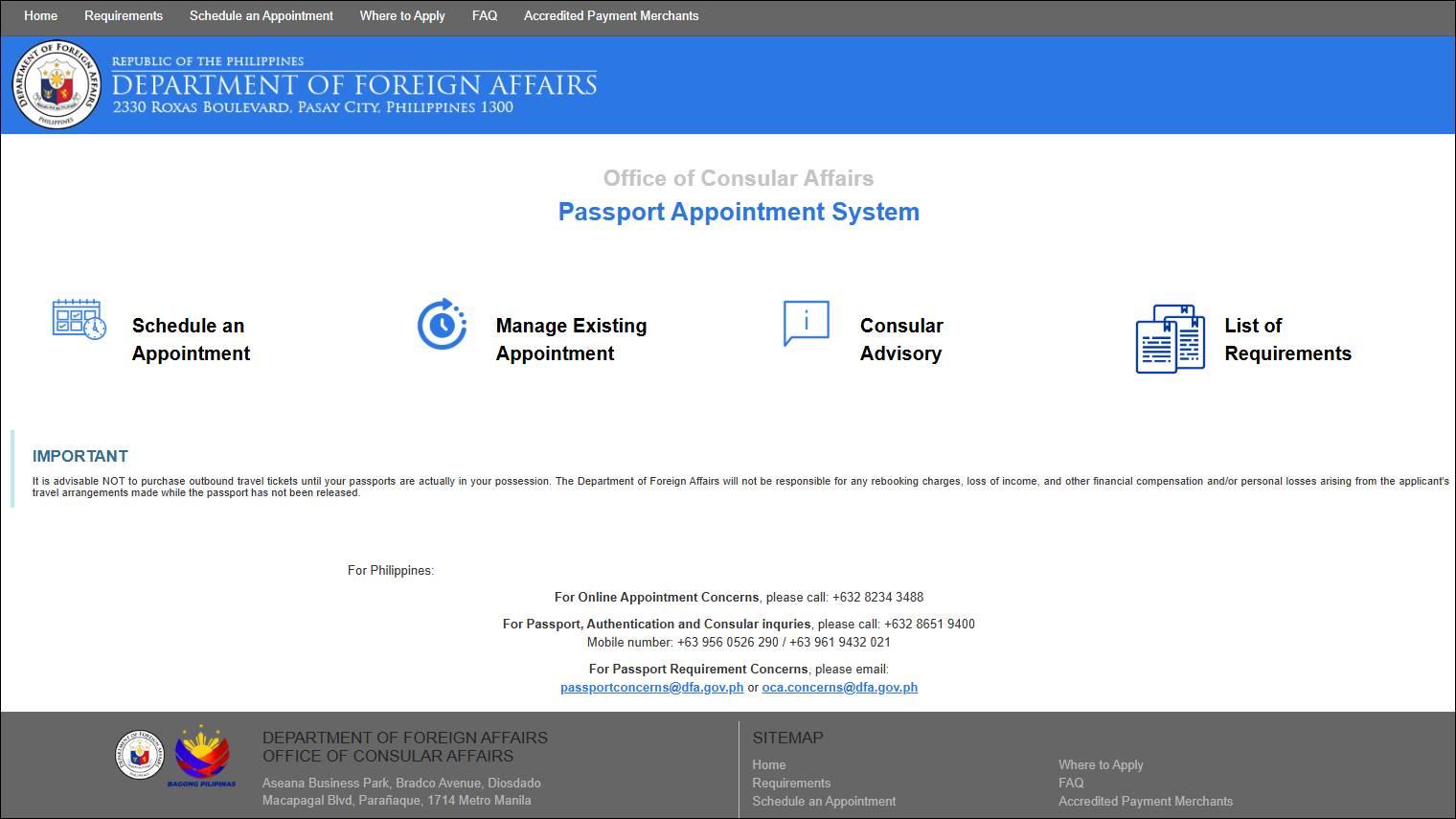
Online Appointment Booking Steps
The DFA has fully digitized its appointment process to manage applications efficiently. All applicants, with a few exceptions, must book a slot through the official Philippine Passport Online Appointment System. Attempting to apply without a confirmed schedule will result in being turned away.
Follow these steps to successfully book your passport appointment:
- Visit the Official Portal: Open your web browser and go to the official DFA Passport Appointment website:
https://www.passport.gov.ph/. Be cautious of fake or look-alike sites. - Start a New Appointment: On the homepage, review the terms and conditions. Once you agree, you can begin the scheduling process. Choose whether you are booking an individual or group appointment.
- Select Your Location: You will be prompted to choose a DFA Consular Office or a Temporary Off-site Passport Service (TOPS) location. Select the site that is most convenient for you. Availability will vary by location.
- Choose a Date and Time: A calendar will display available dates in green. Select your preferred date, and then choose an available time slot for that day. If no slots are visible, it means the schedule is full. Check back regularly, as new slots are opened and canceled appointments become available.
- Complete the Application Form: You must fill out an online form with your personal information. This includes your full name, date of birth, place of birth, contact details, and parental information. Double-check every entry for accuracy, as errors can cause significant delays.
- Pay the Passport Fee: After submitting the form, you will receive a reference number and instructions for payment. You must pay the fee through one of the DFA’s authorized payment partners within the specified timeframe. Failure to pay on time will result in the automatic cancellation of your appointment.
- Confirm and Print: Once your payment is processed, you will receive a confirmation email. This email contains your completed application form, a QR code, and your appointment details. Print this document, as you must bring it with you on your scheduled date.
Requirements
Being prepared with the correct documentation is non-negotiable for a successful passport application. The requirements vary based on the type of application—whether it’s for a new passport, a renewal, or for a minor.
For Adult First-Time Applicants
If you are 18 years or older and applying for your first passport, you will need the following:
- Confirmed Online Appointment: A printout of your application packet with the QR code.
- Completed Application Form: This is part of the packet you print after booking.
- PSA Birth Certificate: The original and one photocopy of your Birth Certificate issued by the Philippine Statistics Authority (PSA). It must be clear and readable. If the details on the PSA copy are unreadable, you must obtain a new copy from the PSA or a certified true copy from your Local Civil Registrar.
- Valid Government-Issued ID: An original and photocopy of at least one valid government-issued identification card. The ID must contain your full name, photo, and signature. Preferred IDs include the PhilID (National ID), Driver’s License, SSS/GSIS/UMID card, or PRC ID.
- For Married Women Using Spouse’s Surname: Original and photocopy of your PSA-issued Marriage Certificate.
For Adult Passport Renewal
Renewing your passport is generally simpler, especially if you have your old passport.
- Confirmed Online Appointment: Printout of your confirmed schedule.
- Completed Application Form: Printed from the appointment system.
- Current ePassport: Your most recent passport. Bring the original and a photocopy of the data page (the page with your photo and personal details).
- Valid ID (if necessary): While the old passport often suffices, it is wise to bring another valid ID just in case.
Additional Documents for Renewals
- For Lost Passports: If your valid passport was lost, you must submit a Police Report (in English) and a notarized Affidavit of Loss. There is also a penalty fee.
- For Women Changing Their Name: If you are renewing and changing your surname after marriage, you must provide the original and a photocopy of your PSA Marriage Certificate. If reverting to your maiden name due to annulment or widowhood, you must present an annotated PSA Marriage Certificate or the PSA Death Certificate of your spouse, respectively.
For Minor Applicants (Below 18 Years Old)
Minors have specific requirements to protect their identity and welfare.
- Confirmed Online Appointment: Minors must have their own appointment, though they can be booked as part of a group with a parent.
- Personal Appearance: The minor applicant must be physically present, accompanied by at least one parent or a legal guardian.
- PSA Birth Certificate: Original and photocopy.
- Parent’s/Guardian’s ID: Original and photocopy of the valid ID of the accompanying parent or legal guardian. If the parents are married, either one can accompany the child.
- Parental Marriage Certificate: If the minor is legitimate and accompanied by only one parent, the PSA Marriage Certificate of the parents is required.
- For Illegitimate Minors: The child must be accompanied by the mother. If the mother cannot be present, she must provide a Special Power of Attorney (SPA) authorizing another adult to accompany the child.
- For Legal Guardians: A court-issued Letter of Guardianship is required.
Costs of a Philippine Passport
The passport fee depends on how quickly you need it processed. You will select your preferred processing speed during the online application.
| Service Type | Fee | Processing Time (Metro Manila) | Processing Time (Provincial) |
|---|---|---|---|
| Regular Processing | Php 950 | Approximately 10-12 working days | Approximately 12-15 working days |
| Expedited Processing | Php 1,200 | Approximately 5-6 working days | Approximately 7-8 working days |
| Penalty for Lost/Mutilated Passport | Php 350 | Added to the base processing fee | Added to the base processing fee |
Note that these timeframes are estimates and do not include the time for courier delivery. If you opt for your passport to be delivered, expect an additional 10 to 15 working days.
Walk-In Exemptions / Courtesy Lane
While the online appointment is mandatory for the general public, the DFA provides a “Courtesy Lane” for certain individuals, allowing them to apply without a pre-booked schedule. This privilege is extended to:
- Senior Citizens: Individuals aged 60 and above. They are allowed to bring one immediate family member who can also apply on the same day.
- Persons with Disabilities (PWDs): Must present a valid PWD ID. They can also be accompanied by one assistant or family member who can apply as well.
- Pregnant Women: Must present a medical certificate or show visible proof of pregnancy.
- Solo Parents: Must present a valid Solo Parent ID issued by their local DSWD.
- Minors Aged 7 and Below: Must be accompanied by their parent(s) or legal guardian. The accompanying adult can also apply or renew their passport at the same time.
- Overseas Filipino Workers (OFWs): Active OFWs with sufficient proof of their status, such as a valid employment contract or OEC, can use the courtesy lane for urgent renewals.
- Emergency and Urgent Cases: Applicants with verifiable urgent travel needs (e.g., medical emergency, death of a family member abroad) may be accommodated. This is subject to the approval of the DFA officer on-site and requires extensive documentation.
Even if you qualify for the Courtesy Lane, you must still bring all the required documents for your application type.
Essential Tips for Your Appointment Day
- Bring all required documents (originals and photocopies).
- Follow the dress code.
- Arrive at least 30 minutes early.
- Personal appearance is required.
- Avoid fixers outside the DFA office.
Special Cases
The DFA has processes for special situations.
Adopted Children
For adopted minors, you’ll need the amended PSA Birth Certificate with the adoptive parents’ names and the court’s Decree of Adoption or the NACC-issued Order of Adoption.
Application Form Errors
Minor typos can be corrected during your appointment; just inform the DFA processor. However, major errors in your name or birthdate may require a new appointment. Double-check your form before submitting.
Late Birth Registration
If your birth was registered late, bring supporting documents like a baptismal certificate or old school records (Form 137) to prove your identity.
Frequently Asked Questions (FAQs)
1. How do I set a DFA passport appointment?
Go to passport.gov.ph, fill out the form, choose your site, date, and time, then pay the fee according to the instructions.
2. Can I walk in at DFA without an online appointment?
No, except for those eligible for the courtesy lane: senior citizens, PWDs, pregnant women, solo parents, minors aged 7 and below (with guardians), OFWs, and emergency cases.
3. What IDs are accepted for passport applications?
PhilID (National ID), driver’s license, SSS/GSIS/UMID, PRC ID, and other government-issued IDs with your full name, photo, and signature are accepted.
4. How much does a Philippine passport cost?
Regular processing is Php 950; expedited processing is Php 1,200. There’s a Php 350 penalty for lost or mutilated passports.
5. What if I lose my scheduled appointment or can’t make it?
Unpaid appointments automatically expire. If you already paid, cancel through the DFA portal before booking a new slot.
6. Can I renew my passport even if it hasn’t expired yet?
Yes. You can renew as early as one year before expiration; make sure your passport is valid for 6 months before international travel.
7. What happens if there’s an error in my online application form?
Minor errors can be fixed during the appointment. Major mistakes, like in your name or birthdate, may require rebooking.
8. Can I bring someone with me to my appointment?
Only applicants are admitted inside. However, minors, PWDs, senior citizens, and other courtesy lane users can be accompanied by a guardian or assistant.
9. How long does it take to get my passport?
Processing times are 5–6 working days for expedited service in Metro Manila and 7–8 days elsewhere. Regular processing takes 10–12 days in Metro Manila. Add extra days if you choose courier delivery.