The Department of Foreign Affairs (DFA) often collaborates with other government agencies on various programs and projects. One of these agencies is the Public-Private Partnership (PPP) Center, the main coordinating and monitoring agency for all PPP projects in the country.
Based on R.A. 11966 or the PPP Code of the Philippines, the PPP Center facilitates the implementation of the country’s PPP program and projects. It provides technical and institutional support to Implementing Agencies (IAs), including government agencies, government financial institutions, state universities and colleges, and local government units (LGUs).
Vision, Mission, and Core Values
According to its official website, the PPP Center is envisioned to be “a globally recognized institution advancing inclusive and sustainable development for the Filipino people.”
Correspondingly, the Center’s mission is to “improve the lives of the Filipinos through efficient and effective PPP facilitation that delivers transformative infrastructure and development services.”
Notably, the PPP Center operates with these core values in mind: Responsiveness, Integrity, Stewardship, and Excellence.
Organizational Structure
The PPP Center is headed by an Executive Director, who has the rank of “Undersecretary.” He/She is supported by two Deputy Executive Directors.
Furthermore, the Center is comprised of eight departments, each of which specializes on a specific service:
- Administrative Service;
- Capacity Building and Knowledge Management Service;
- Legal Service;
- Policy and Planning Service;
- Project Development Service;
- Project Evaluation Service;
- Project Monitoring Service; and
- Project Development and Monitoring Facility Service.
Infrastructure or Development Projects and Services
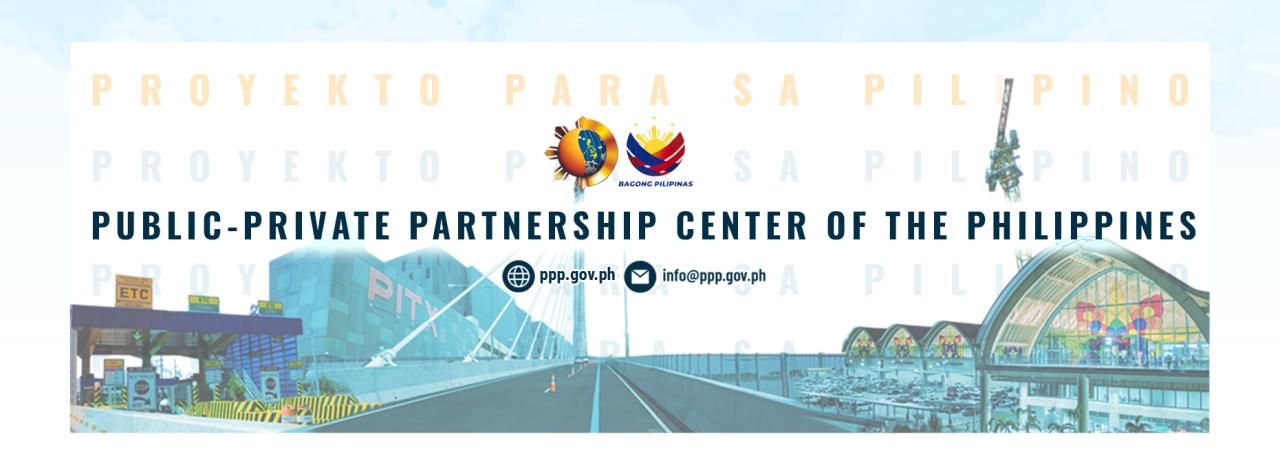
Basically a “Public-Private Partnership” or PPP refers to a contractual agreement between an Implementing Agency (IA) and a Private Partner (PP) to design, finance, construct, operate, and/or maintain infrastructure or development projects and services.
Typically, these infrastructure or development projects include:
- Agribusiness facilities, agri-fishery industrial hubs, research facilities, agricultural estates, contract farming, and related facilities;
- Airports, air navigation, and related facilities;
- Clinics, hospitals, clinical laboratories, research facilities, and other health infrastructure;
- Cold chain systems or centers, and related-facilities;
- Downstream oil and gas industry facilities, and other energy-related facilities;
- Ecotourism projects, coastal/marine nature parks, and related facilities;
- Educational infrastructure and related facilities;
- Government buildings, convention centers, and other related facilities;
- Heritage preservation and adaptive reuse projects;
- Information technology networks, database infrastructure, geo-spatial resource mapping, and related facilities;
- Irrigation and related facilities;
- Land reclamation, dredging, flood control projects, and related facilities;
- Markets, slaughterhouses, trading posts, and related facilities;
- Power generation plants, hydropower plants, distribution, transmission, sub-transmission, and other related facilities;
- Public fish ports, fishponds, storage, and processing facilities;
- Road-based transportation systems, bus rapid transit, public utility vehicle stations, railways, park and ride, transport plazas, inter-modal terminals, and other land transportation systems;
- Roads, highways, expressways, tunnels, bridges, viaducts, and other related facilities;
- Roll-on roll-off facilities, piers, quays, wharves, storage and handling facilities, and other port infrastructure;
- Shipping vessels and components, shipping and ferry services, navigable inland waterways, and other maritime infrastructure;
- Telecommunications, terrestrial, aerial, and space infrastructure, and related service facilities;
- Traffic monitoring systems, traffic enforcement systems, automated fare and toll collection systems, transportation databases, and other transport and traffic management projects;
- Urban redevelopment, townships, and housing projects;
- Warehouses and post-harvest facilities; and
- Water supply, drainage, desalination, waste water and water treatment, and related facilities.
Contact Information: PPP Center
For inquiries and concerns, interested parties can get in touch with the PPP Center through the following contact details:
Address: 8th Floor, One Cyberpod Centris, Eton Centris, Epifanio de los Santos Ave, Quezon City, 1101 Kalakhang Maynila
Telephone: 02 8709 4146
Email: info@ppp.gov.ph
Website: https://ppp.gov.ph/
Facebook: https://www.facebook.com/PPPCenter.Philippines
Google Map:
By bringing together public and private institutions and resources, the PPP Center plays a key role in the country’s progress, particularly in terms of essential infrastructure as well as development projects and services.
Meanwhile, another agency that the DFA usually coordinates with is the Commission on Filipinos Overseas (CFO). Visit this link to read all about it.