Among the agencies that the Department of Foreign Affairs (DFA) works with is the Department of Trade and Industry (DTI), which is responsible for managing, promoting, and regulating the country’s industry and trade.
Today, the DTI oversees 17 regional offices across the Philippines, as well as 87 city/provincial offices, plus several bureaus and attached agencies. Outside the country, it also operates 27 foreign trade service posts, stationed around the world.
Vision, Mission, and Core Values
Based on its official website, the DTI envisions “a more inclusive and prosperous Philippines with employment and income opportunities for all.”
Consequently, the agency’s mission is to be “the main economic catalyst that enables innovative, competitive, job-generating, inclusive businesses, and empowered consumers.”
Moreover, the DTI operates on the following core values: Competence, Creativity, Synergy, Passion, Integrity, and Love for Country.
Organizational Structure
The Department is headed by the Secretary of Trade and Industry, who is assisted by seven Undersecretaries and five Assistant Secretaries. Each one is in charge of a specific sub-department or group, as follows:
- Undersecretary/Chief of Staff, Office of the Secretary;
- Undersecretary for Communications;
- Undersecretary for Competitiveness and Innovation Group;
- Undersecretary for Consumer Protection Group;
- Undersecretary for Industry Development and Trade Policy Group;
- Undersecretary for Management Services Group;
- Undersecretary for Regional Operations Group;
- Assistant Secretary, Office of the Secretary;
- Assistant Secretary for Foreign Trade Service Corps;
- Assistant Secretary for Regional Operations Group; and
- Assistant Secretaries for Industry Development and Trade Policy Group.
Key Programs
The key programs of the DTI include those that focus on MSME development, financial assistance, consumer protection, fair trade, and export development.
MSME Development
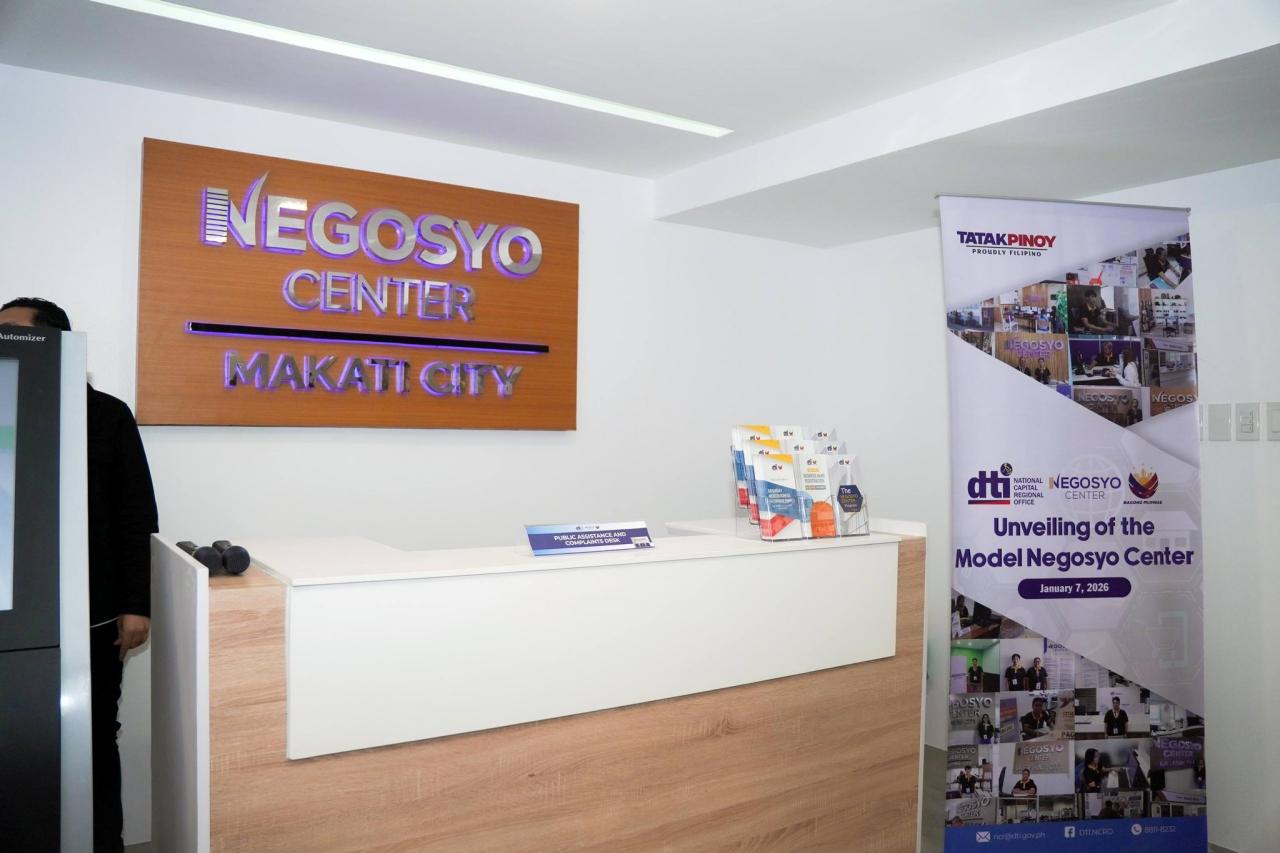
The Department provides training, support, permits, and various programs for Micro, Small, and Medium Enterprises or MSMEs. These include the establishment of Negosyo Centers, which facilitate advisory services, business registration, and access to funding nationwide.
In addition, the DTI implements the Kapatid Mentor ME (KMME), a mentoring program for entrepreneurs who want to “level up” their businesses, and the Shared Services Facilities (SSF) program, which provides MSMEs with machinery, equipment, and other productivity tools.
Finally, the Department introduced the Startup Pinay/SheTrades Philippines Hub, which involves e-learning, access to global markets, and various initiatives for female entrepreneurs.
Financial Assistance
The DTI provides financial assistance through the Pondo sa Pagbabago (P3) Program, a microfinance initiave through the Small Business Corporation, and the OFW Reintegration program, which grants loans up to PHP 5 million for returning OFWs who want to start businesses.
Consumer Protection
The Department actively monitors prices of basic goods and services, and product standards — making sure that they are fairly priced, properly labeled, and safe. It also handles consumer complaints, while enforcing laws against abusive and deceptive business practices.
Fair Trade
The DTI makes sure that market competition is fair for everyone; it seeks to prevent businesses/companies from taking advantage of their consumers or other companies.
Export Development
Through policies and programs, the DTI supports export development, helping local industries and promoting Filipino products globally.
Contact Information: DTI Head Office
The DTI Head Office may be reached through the following contact details. Its office hours are 8:00 am to 5:00 pm, Mondays to Fridays.
Address: 387 Sen. Gil J. Puyat Ave, Makati City, 1200 Metro Manila
Telephone: 02 7791 3100
Email: ask@dti.gov.ph
Website: https://www.dti.gov.ph/
Facebook: https://www.facebook.com/DTI.Philippines
Google Map:
By helping local business, promoting Filipino products, and enforcing policies, the DTI plays a major role in the country’s economic development. Meanwhile, when it comes to workers’ rights and welfare, it’s the Department of Labor and Employment (DOLE) that takes the lead. Visit this link to learn more about this agency.